Nano Banana 2.1 vs Pro
Compare image quality, creative control and the details that matter for your next project.
Nano Banana 2.1
Google positions this model around efficient image generation and conversational editing. A useful starting point for exploring ideas and refining a visual direction.
Official model detailsNano Banana Pro
Google positions Pro around demanding creative work, including complex layouts, product mockups and grounded visual information. Evaluate it against your production requirements.
Official model detailsNano Banana 2.1 vs Pro: specifications
Model capabilities documented by Google. Features available in a particular app can be a smaller subset.
Scroll the table horizontally to compare both models.
| Capability | Nano Banana 2.1 | Nano Banana Pro |
|---|---|---|
| Google’s positioning | Efficient image creation and conversational editing | Advanced control for complex visual production |
| API model ID | gemini-nano-banana-2.1 | gemini-3-pro-image |
| Core workflow | Text-to-image and reference-based editing | Text-to-image and reference-based editing |
| Output sizes | 1K, 2K and 4K | 1K, 2K and 4K |
| Reference images | Up to 14 in the model API | Up to 14 in the model API |
| Documented reference mix | Up to 4 characters and 10 objects | Up to 5 characters, 6 objects and 3 style references |
| Search grounding | Supported | Supported |
| AI provenance | Invisible SynthID | Invisible SynthID |
Using our generator: this independent website offers Nano Banana 2.1 at 1K with one reference image. Pro, 4K controls and search-grounding controls are not available in this interface. Free access and downloads without added visible branding are features of this service, separate from the model specifications.
Image comparison: what to look for
Compare the whole composition and the small details. These illustrations show inspection criteria; they are not matched outputs from Nano Banana 2.1 and Pro.
Product shape & surface detail
Illustrative image · not a model test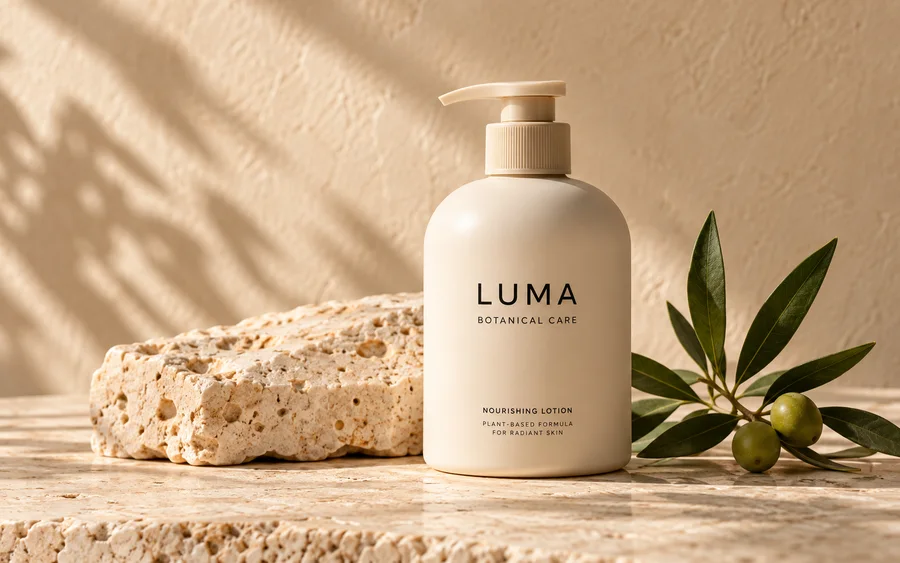
What to check in both models
- Does the bottle keep a believable shape?
- Do the light, shadow and reflections agree?
- Is the label readable without inventing extra text?
Prompt for your own comparison
A minimalist ivory skincare pump bottle labeled "LUMA", centered on pale travertine beside an olive branch. Warm beige plaster background, natural shadows, premium botanical skincare photography. Keep the bottle straight and the label readable. Landscape 4:3.
Google’s published comparison scores
Selected Elo results from Google DeepMind’s October 2026 evaluation. These are provider-reported measurements, not tests conducted by this website.
Scroll the table horizontally to see all scores.
| Evaluation | 2.1 Thinking | 2.1 No Thinking | Nano Banana Pro |
|---|---|---|---|
| Overall preference | 1050 ± 14 | 1015 ± 13 | 935 ± 8 |
| Infographic design | 1048 ± 17 | 1001 ± 17 | 912 ± 12 |
| General editing | 1026 ± 12 | 980 ± 15 | 939 ± 10 |
| Multi-character consistency | 1106 ± 14 | 1068 ± 14 | 1011 ± 10 |
| Product consistency | 1024 ± 18 | 981 ± 18 | 965 ± 14 |
The selected results favor Nano Banana 2.1 in this evaluation. Elo scores are not percentages: a higher score does not translate directly into a percentage improvement in image quality. The model card uses side-by-side human evaluations. Task coverage, settings and the prompts in your own workflow still matter.
Which model should you choose?
For a Nano Banana 2.1 vs Pro decision, begin with the work you need to finish. A social post, a product campaign and a technical diagram have different failure costs. Write down what would make an image unusable before judging how attractive it looks. A beautiful label with the wrong wording can be a worse result than a simpler composition with the correct information.
Start with Nano Banana 2.1 for a new visual direction
Our recommendation is to try Nano Banana 2.1 first for exploratory work: testing compositions, developing a mood board or changing the setting around a subject. Keep the first brief small enough to evaluate. If the scene is right but one detail is wrong, isolate that detail in the next instruction. You will learn more from a focused revision than from changing the subject, lighting and style together.
Evaluate Pro against a specific production requirement
Include Nano Banana Pro in your shortlist when a brief has tightly connected requirements, such as several references, a localized campaign or a carefully specified layout. Its professional positioning makes it a relevant candidate, but your acceptance criteria should decide the outcome. If you already have an effective Pro workflow, compare representative briefs before replacing it. A name alone is not a reason to change a process that works.
Judge the finished workflow, not only the first image
Record how much work each result needs after generation. Count the revisions needed to restore a product shape, correct a title or remove an unwanted object. Include time spent reviewing outputs and preparing the final export. The useful comparison is the effort required to reach an acceptable asset, especially when a project has many images that must feel related.
How to run a fair image comparison
Use the example prompts above as starting briefs for a Nano Banana 2.1 vs Pro test. The illustration beside a prompt explains what to inspect; it is not an expected output. Save the exact prompt and original reference files so another person can repeat the same task.
- Match the inputs. Give both models the same wording, files, aspect ratio and requested output size. Avoid improving one model's prompt after seeing the other model's result.
- Record the settings. Keep the exact model ID, generation date, thinking setting and search setting with each result. If the services expose different controls, describe the difference instead of calling the runs identical.
- Keep every attempt. Generate several samples under each configuration and retain failures as well as successes. Do not select one model's best image and the other model's weakest image.
- Inspect without the labels. Hide the model names while comparing composition, text, object fidelity and instruction following. Then reveal the names and record the reasons for your choice.
- Report the result narrowly. Describe the prompt and the specific difference you observed. A result on one product photograph does not establish a winner for portraits, diagrams or every editing task.
For timing, use the same connection and measure from submitting the request to receiving the completed image. Report the number of attempts and a typical value, rather than the fastest isolated run. For cost, include rejected attempts and revisions when calculating the cost of an image you can actually use.
When publishing a comparison, keep the original outputs available alongside any detail crops. Apply the same display scale and compression to both images. If you retouch, upscale or color-correct an output, label that processing. Those changes can hide the differences the comparison is meant to reveal.
Nano Banana 2.1 vs Pro FAQ
Is Nano Banana 2.1 better than Nano Banana Pro?
Google’s October 2026 evaluation reports higher Nano Banana 2.1 scores on the selected tasks shown above. That is evidence about the provider’s test set, not a promise for every prompt. Use your own brief, matching settings and several outputs to decide which result needs less correction.
Is Nano Banana Pro the same as Nano Banana 2.1?
No. They have separate model IDs: gemini-nano-banana-2.1 and gemini-3-pro-image. A service’s product name or subscription label may be different from the underlying model. Check the exact model before comparing results.
Which should I try for product images or posters?
Start with the task’s hardest requirement. For products, inspect shape, reflections and label fidelity. For posters, inspect exact wording and reading order. Choose a model using the results of those checks, rather than assuming that a newer version or the Pro name always wins.
Can I generate with both models on this website?
This website’s generator is designed for Nano Banana 2.1. It offers 1K output and one uploaded reference per request. Nano Banana Pro is discussed here for comparison; there is no Pro model selector in this interface.
Are the images on this page a real head-to-head test?
No. The visual inspection examples are illustrative assets, shown as a full image and a detail view. They are not attributed to either model. The score table is sourced from Google; we have not published our own matched-prompt image benchmark.
Does free generation mean the model API is free?
No. This website offers free generation subject to service availability and fair-use limits. That offer is separate from Google’s API billing and the access rules of other products. Compare costs using the provider and resolution you actually plan to use.
Sources and editorial notes
Reviewed October 7, 2026. Specifications and evaluation scores come from the official references below. Selection advice and the inspection checklist are our editorial interpretation. The illustrative images do not establish a model ranking.
Try your own image brief
Open the Nano Banana 2.1 generator. No sign-up required.